
History of the Cooperative
For almost 90 years, the Osage Valley Electric Cooperative has provided electricity to residents of West Central Missouri. However, our organization was never as organized as it is today. This program started with a group of farmers who saw the potential of bringing electricity to the region. It was made possible by the tireless efforts of our founders, who lobbied to bring the first electric poles to the region. Step back into history and learn about the Osage Valley Electric Cooperative.
It All Started in 1935…
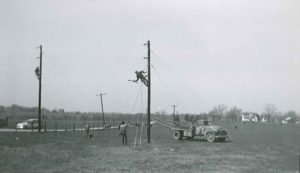
In the 1930s, America was in the middle of the Great Depression. Only residents in urban areas had access to electricity, while America's rural farmers continued to rely on candles and gas-powered lamps. Electric companies thought it was unprofitable to bring electric lines to rural areas and didn’t think there were enough people who could afford the high cost.
On May 11, 1935, President Franklin D. Roosevelt signed an executive order that created the Rural Electrification Administration. This program brought electric lights and power to millions of Americans, who were literally living in the dark. When REA was born, barely 11 percent of the farmers in America had central station electricity; this was about to change.
The Electric Cooperative Was Formed
The Rural Electrification Act was a long-term loan program that made it possible for rural communities to work together to bring electricity to their regions. A few far-sighted and hard-working people of West Central Missouri began working to provide electricity for themselves. These dedicated individuals saw the potential of electrical power and traveled from farm to farm to “get lights” on a cooperative basis.
Once word got out that an REA Cooperative was being formed in the area, group meetings were held in area schoolhouses to discuss the program and get community buy-in. Members had to sign up with a $5 fee – a substantial sum at the time. Some farmers were unsure whether the electricity was worth the expense.
During the early months of the organization, the Board of Directors met on almost a weekly basis. Most of the Directors’ time was spent organizing and planning for the new Rural Electric Cooperative.
Electricity Comes to West Central Missouri
Osage Valley Electric Cooperative was officially incorporated on August 9, 1938. The Cooperative’s first loan application to the REA was approved in February 1939. A construction contract was approved later that August to build approximately 352 miles of rural distribution line. Construction on this project was completed in May of 1940, with about 177 members receiving electricity for the first time.
A few weeks later, a second project was completed and additional members were added. By the end of 1940, there were 779 members. The Electric Cooperative had reached its goal of bringing electricity to rural Missouri.
WWII Stops the Construction of Electric Lines
By 1941, World War II was in full swing and the majority of American resources were allocated to the war effort. Virtually all construction of new electric distribution lines was stopped because of the lack of sufficient line materials. Labor was also hard to find at this time because so many men were fighting abroad.
During the war years, about 500 new members were added to the Cooperative’s lines, which now numbered about 524 miles.
Osage Valley Electric Cooperative Continues to Grow
In 1939, the Cooperative moved into office space in the Anderson Building on the east side of the square in Butler. In addition to the project superintendent, a bookkeeper-stenographer was hired, and the Cooperative now had two employees. By 1961, thirty-eight employees were working for Osage Valley. Eventually, the cooperative would move to its current office at 1321 North Orange Street.
Because the Cooperative’s service area was growing rapidly in Henry County, it was necessary to establish an area office in Clinton, Missouri. Today, the cooperative still has a presence just north of Highway 7, in the northwest part of Clinton.
Osage Valley Electric Cooperative had to purchase electric power to furnish its members. Originally, wholesale power was purchased from the City of Butler, the City of Harrisonville, and the Missouri Public Service Co. In 1948, Osage Valley entered into a contract to purchase all of its wholesale power from KAMO Power Electric Cooperative, headquartered in Vinita, Oklahoma.
KAMO Power still supplies the wholesale power for the Cooperative. It is one of six transmission cooperatives that receives power from Associated Electric Cooperative Inc. AECI is the cooperative responsible for the generation of electricity for all 40 Missouri electric cooperatives, nine Oklahoma cooperatives, and three Iowa electric cooperatives.
Fiber Optic Comes to West Central Missouri
In 2021, Osage Valley began constructing a fiber optic network to provide high-speed internet for its members. While Osage Valley owns the fiber optic network, it partnered with Conexon Connect to be its internet service provider. The first home was connected in February 2022, and most residents have fiber optic connections today. Fiber optic continues to draw businesses to the region because of the promise of fast, reliable internet.
Osage Valley Electric Cooperative Today
Today, Osage Valley Electric Cooperative serves more than 17,500 meters on 3,750 miles of rural distribution lines. The Cooperative has fifty employees dedicated to serving its members with the most economical and reliable electric power possible.
Because of electricity:
- The service area of Osage Valley is a much better place to live.
- The standard of living for families living in the rural area of West Central Missouri has risen dramatically.
- Farmers have increased their productivity, which allows them to help feed the world.
- Industries and businesses have moved to rural areas providing many jobs for residents.
- Citizens of West Central Missouri have a real choice between living in urban areas or rural areas.
Because of electricity and broadband, the rural areas served by Osage Valley Electric Cooperative are a place where services and opportunities are now a reality, not just a dream.


